

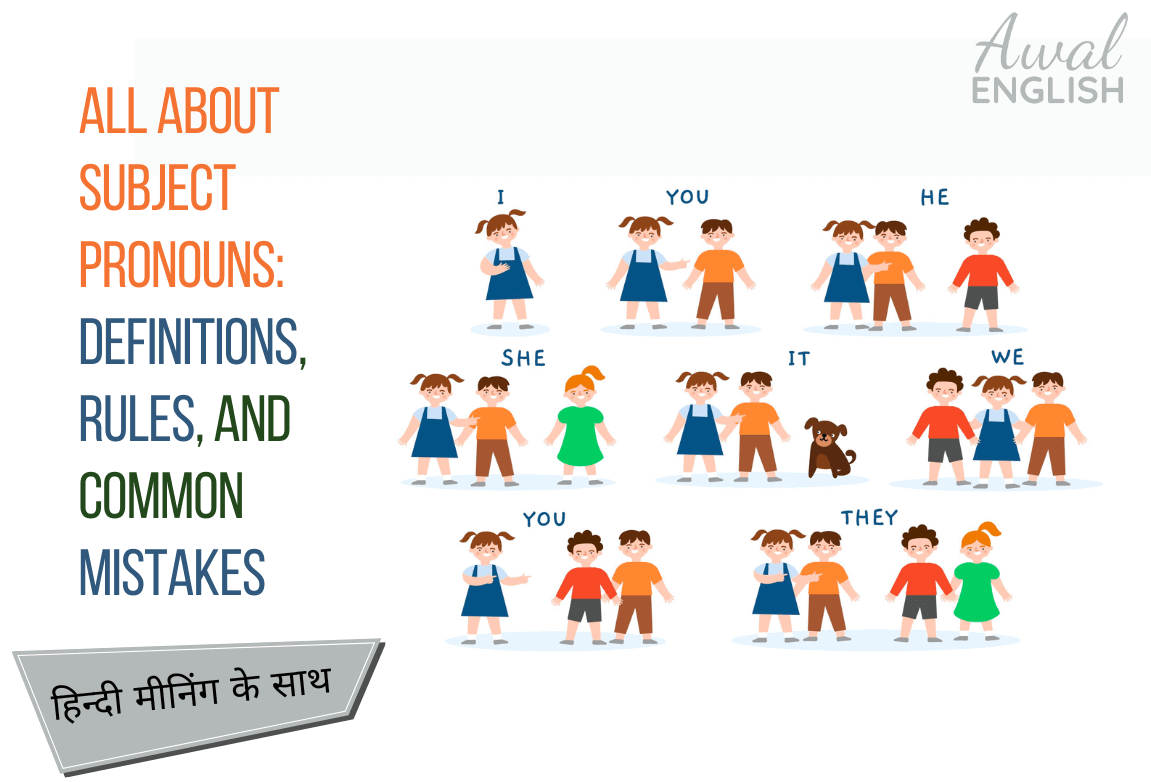
Subject pronouns are a specific type of pronoun that function as the subject of a sentence. They identify who or what is performing the action in a sentence, enhancing clarity and flow. For instance, instead of saying, “Nidhi went to the market, and Nidhi bought fruits,” we use the subject pronoun “she” to replace “Nidhi,” resulting in, “Nidhi went to the market, and she bought fruits.”

What is a Subject Pronoun?
A subject pronoun is a pronoun that takes the place of a noun as the subject of a sentence, indicating who or what is doing the action. Subject pronouns are essential for making sentences concise and easier to understand. They change based on number (singular/plural) and person (first/second/third person).
Common subject pronouns include “I,” “you,” “he,” “she,” “it,” “we,” and “they.” In the sentence “He is reading a book,” the pronoun “he” serves as the subject, showing who is performing the action.
Subject pronoun वह pronoun होता है जो sentence में noun की जगह लेकर subject के रूप में कार्य करता है। यह specify करता है कि कौन action कर रहा है। Subject pronouns number (एकवचन/बहुवचन) और person (पहला/दूसरा/तीसरा) के अनुसार बदलते हैं। कुछ सामान्य subject pronouns हैं:
- I – मैं
- You – तुम / आप
- He – वह (लड़के के लिए)
- She – वह (लड़की के लिए)
- It – यह (चीज़ या जानवर के लिए)
- We – हम
- They – वे
Example – “वह एक किताब पढ़ रहा है,” में “वह” subject pronoun के रूप में कार्य करता है।
Definition of a Subject Pronoun
A subject pronoun replaces a noun as the subject of a sentence, helping to avoid repetition and providing clarity by indicating who or what is performing the action. Subject pronouns are used in the first, second, and third person and can be singular or plural. Examples include “I,” “you,” “he,” “she,” “it,” “we,” and “they.”
Subject pronoun वह pronoun है जो किसी noun की जगह subject के रूप में लेता है, repetition से बचाता है, और clarity प्रदान करता है। यह दिखाता है कि कौन या क्या action कर रहा है। Subject pronouns पहले, दूसरे, और तीसरे व्यक्ति में हो सकते हैं और singular या plural हो सकते हैं।
Examples – “I,” “you,” “he,” “she,” “it,” “we,” और “they” subject pronouns हैं।
Tricky Subject Pronoun Examples
Sometimes, understanding subject pronouns can be challenging, especially when selecting the correct pronoun based on person or number. Here are some examples of commonly misused subject pronouns:
Subject pronouns का सही use करना कई बार कठिन हो सकता है, खासकर जब व्यक्ति (person) या संख्या (number) के अनुसार सही pronoun चुनना हो। यहां कुछ commonly misused subject pronouns के examples हैं:
1. He/She
Incorrect: “Her is going to the store.”
Correct: “She is going to the store.”
Hindi: “वह दुकान जा रही है।”
Note: Use “she” as the subject pronoun rather than “her,” which is an object pronoun.
2. They
Incorrect: “Them went to the concert.”
Correct: “They went to the concert.”
Hindi: “वे concert में गए।”
Note: “They” is the subject pronoun, while “them” is the object pronoun.
3. We/Us
Incorrect: “Us are going to the museum.”
Correct: “We are going to the museum.”
Hindi: “हम museum जा रहे हैं।”
Note: “We” is used as the subject, while “us” is the object.
Subject Pronouns Sentences
Here are some common examples of subject pronouns used in sentences, along with their Hindi translations:
English: “I am studying for my exams.”
Hindi: “मैं अपनी exams की तैयारी कर रहा हूँ।”
English: “They are watching a movie together.”
Hindi: “वे साथ में एक movie देख रहे हैं।”
English: “He plays the guitar well.”
Hindi: “वह Guitar अच्छा बजाता है।”
English: “She is visiting her grandparents.”
Hindi: “वह अपने दादा-दादी से मिलने जा रही है।”
English: “We are building a new project.”
Hindi: “हम एक नया project बना रहे हैं।”
When Do We Use Subject Pronouns?
We use subject pronouns to indicate who or what is performing the action in a sentence, replacing specific nouns to make sentences clearer and less repetitive. Subject pronouns represent the speaker (first person), the person being addressed (second person), or the person or thing being discussed (third person). For instance, in sentences like “She is reading a book” or “They are playing soccer,” subject pronouns replace names like “Anita” or “the boys.”
हम subject pronouns का उपयोग यह दिखाने के लिए करते हैं कि कौन या क्या action कर रहा है, जिससे sentence को साफ़ और concise बनाया जा सके। Subject pronouns उस व्यक्ति या चीज़ का साथ देते हैं जो बोल रहा है (पहला व्यक्ति), जिससे बात हो रही है (दूसरा व्यक्ति), या जिसके बारे में बात हो रही है (तीसरा व्यक्ति)। उदाहरण के लिए, “वह किताब पढ़ रही है” या “वे फुटबॉल खेल रहे हैं” में subject pronouns “Anita” या “लड़कों” की जगह पर use किए गए हैं।
Subject Pronoun Rules
1. Use Subject Pronouns to Avoid Repetition
Subject pronouns help eliminate the need to repeat nouns, making sentences concise and easier to understand.
Example:
Without Pronoun: “Anita loves painting, and Anita paints every day.”
With Pronoun: “Anita loves painting, and Anita paints every day.”
Hindi:
Without Pronoun: “Anita को Paintings पसंद है, और Anita हर दिन painting करती है।”
With Pronoun: “Anita को Paintings पसंद है, और वह हर दिन painting करती है।”
2. Singular and Plural Forms
Make sure subject pronouns agree with the number of the noun they replace. Singular pronouns (I, he, she, it) represent one entity, while plural pronouns (we, they) represent more than one.
Example:
Singular: “She is studying.”
Hindi: “वह पढ़ रही है।”
Plural: “They are studying.”
Hindi: “वे पढ़ रहे हैं।
3. Using “It” for Non-Human Subjects
The pronoun “it” represents non-human subjects like objects, ideas, or animals. In Hindi, “यह” (yeh) or “वह” (vah) is used.
Example:
English: “It is raining.”
Hindi: “बारिश हो रही है।”
4. Subject Pronouns in Compound Subjects
When subject pronouns are part of a compound subject (two or more subjects joined by “and” or “or”), they should be in their subject form.
Example:
Correct: “Tina and I went to the store.”
Hindi: “Tina और मैं दुकान गए।”
Incorrect: “Tina and me went to the store.”
Hindi: “Tina और मुझे दुकान गए।”
5. In Commands (Imperative Form):
Subject pronouns can be used in commands to address someone directly, though they are sometimes omitted in English for brevity.
Example:
English: “You should listen carefully.”
Hindi: “तुम्हें ध्यान से सुनना चाहिए।”
6. “You” as Both Singular and Plural:
In English, “you” serves as both a singular and plural subject pronoun, which can cause confusion. In Hindi, “तुम” (informal singular) or “आप” (formal singular) is used for one person, and “तुम लोग” or “आप लोग” for multiple people.
Example:
English: “You are my friend.” (singular)
Hindi: “तुम मेरे दोस्त हो।” (singular)
English: “You are all invited to the event.” (plural)
Hindi: “तुम लोग event में invited हो।” (plural)
7. Using Subject Pronouns in Relative Clauses
In relative clauses, subject pronouns (who, which, that) introduce clauses referring back to a noun.
Example:
English:“The student who passed the test studied hard.”
Hindi: “वह Student जिसने test pass की, उसने कड़ी मेहनत की।”
English:“The book that you lent me was amazing.”
Hindi: “वह किताब जो तुमने मुझे दी थी, अद्भुत थी।”
8. Using “Who” vs. “Whom”
“Who” is a subject pronoun, while “whom” is an object pronoun. “Who” should be used for the subject of a clause.
Example:
Correct: “Who is coming to the party?”
Hindi: “कौन Party में आ रहा है?”
Incorrect: “Whom is coming to the party?”
Hindi: “किसे Party में आ रहा है?”
Typical Errors with Subject Pronouns
1. Mixing Up Subject and Object Pronouns:
Subject pronouns are sometimes incorrectly used as objects and vice versa.
Example:
Incorrect: “Me is going to the market.”
Correction: “I am going to the market.”
Hindi:
गलत: “मुझे market जा रहा है।”
सही: “मैं market जा रहा हूँ।”
2. Using the Wrong Pronoun in Reported Speech
When relaying someone’s words, ensure the pronoun matches the speaker.
Example:
Incorrect: “She said I should go.”
Correction: “She said you should go.” (if addressing the listener)
Hindi:
गलत: “उसने कहा कि मैं जाऊं।”
सही: “उसने कहा कि तुम जाओ।” (यदि श्रोता को संबोधित कर रहे हैं)
3. Using “It” for People
“It” is typically not used for people, as it can sound disrespectful.
Example:
Incorrect: “It is my friend.”
Correction: “He is my friend.”
Hindi:
गलत: “यह मेरा दोस्त है।”
सही: “वह मेरा दोस्त है।”
4. Confusing “We” and “Us” in Compound Subjects
“We” is a subject pronoun, while “us” is an object pronoun. Using “us” in a subject position is incorrect.
Example:
Incorrect: “Us girls are going on a trip.”
Hindi: “हम लड़कियाँ trip पर जा रही हैं।”
Correct: “We girls are going on a trip.”
Hindi: “हम लड़कियाँ trip पर जा रही हैं।”
Difference Between Subject Pronouns and Object Pronouns
The main difference between subject pronouns and object pronouns is in their grammatical roles within a sentence.
Subject pronouns (e.g., “I,” “you,” “he,” “she,” “we,” “they”) act as the subject of a sentence, meaning they perform the action. They answer “who” or “what” is doing something.
Object pronouns (e.g., “me,” “you,” “him,” “her,” “us,” “them”) act as the object of a sentence, meaning they receive the action of the verb or follow prepositions. They answer “who” or “what” is affected by the action.
Subject pronouns और object pronouns में मुख्य अंतर उनकी वाक्य में भूमिका है। Subject pronouns वाक्य के subject के रूप में कार्य करते हैं और बताते हैं कि कौन कुछ कर रहा है, जबकि Object pronouns वाक्य में object के रूप में कार्य करते हैं और यह दिखाते हैं कि किस पर क्रिया का प्रभाव पड़ रहा है।
Comparison:
Subject Pronoun: “She likes music.”
Hindi: “वह संगीत पसंद करती है।”
Object Pronoun: “Music makes her happy.”
Hindi: “संगीत उसे खुश करता है।”
Subject Pronoun: “They are playing football.”
Hindi: “वे Football खेल रहे हैं।”
Object Pronoun: “The coach praised them.”
Hindi: “Coach ने उनकी तारीफ की।”
Subject Pronoun: “We watched a movie.”
Hindi: “हमने एक Movie देखी।”
Object Pronoun: “The movie impressed us.”
Hindi: “Movie ने हमें प्रभावित किया।”
Subject Pronoun: “He called his friend.”
Hindi: “उसने अपने दोस्त को Phone किया।”
Object Pronoun: “His friend called him back.”
Hindi: “उसके दोस्त ने उसे वापस Phone किया।”
Subject Pronoun: “I am going to the market.”
Hindi: “मैं Market जा रहा हूँ।”
Object Pronoun: “My friend joined me.”
Hindi: “मेरे दोस्त ने मुझे Join किया।”
Importance of Subject Pronouns
1. Clarity in Communication
Subject pronouns help avoid repetition and make sentences clearer. Instead of saying “Aditi went to Aditi’s house,” we can say “Aditi went to her house.”
Subject pronouns एक ही शब्द को बार-बार कहने से बचाने और वाक्यों को स्पष्ट बनाने में मदद करते हैं। “Aditi Aditi के घर गई” कहने के बजाय, हम कह सकते हैं “Aditi अपने घर गई।”
2. Grammatical Structure
They are essential for maintaining the grammatical structure of sentences, as every sentence requires a subject.
वे वाक्यों की सही संरचना को बनाए रखने के लिए जरूरी होते हैं, क्योंकि हर वाक्य में एक विषय की आवश्यकता होती है।
3. Enhancing Understanding
Subject pronouns help listeners and readers understand who is being talked about without confusion. For example, “He is going to the party” clearly indicates who is attending.
Subject pronouns श्रोताओं और पाठकों को यह समझने में मदद करते हैं कि किसके बारे में बात की जा रही है, बिना किसी भ्रम के। Example के लिए, “वह party में जा रहा है” स्पष्ट रूप से बताता है कि कौन भाग ले रहा है।

Practice Questions Related to Subject Pronouns
Fill in the blanks with the correct subject pronoun (choose the correct option in brackets):
- __ (He/They) is my best friend.
- __ (I/Me) am excited about the trip.
- __ (She/Her) is going to the movies.
- __ (We/Us) are planning a surprise party.
- __ (They/Them) are studying for the exam.
- __ (It/Its) is a beautiful day today.
- __ (He/His) loves to play basketball.
- __ (I/Me) went to the store yesterday.
- __ (You/Your) are invited to the meeting.
- __ (She/Her) is an excellent dancer.
Answers:
- He
- I
- She
- We
- They
- It
- He
- I
- You
- She
Common Questions About Subject Pronouns
Q1: What do we mean by a Subject Pronoun?
Answer: A subject pronoun is a word that replaces a noun in a sentence and acts as the subject performing the action. Subject pronouns include “I,” “you,” “he,” “she,” “it,” “we,” and “they.” For example, in the sentence “She is reading a book,” “she” is the subject pronoun indicating the doer of the action.
Q2: Can subject pronouns be used in a gender-neutral way?
Answer: Yes, subject pronouns can be used in a gender-neutral context. The pronoun “they” is often used to refer to someone whose gender is unknown or unspecified, helping to maintain inclusivity. For example: “Rahul said they would join us later.”
Example:
Singular: “Someone left their coat.” (Referring to one person, gender-neutral)
Plural: “They are going to the concert.” (Referring to more than one person)
Q3: How do subject pronouns function in questions?
Answer: In questions, subject pronouns often come after auxiliary verbs or are used to clarify the subject. For example, in “Are they coming to the party?” The subject pronoun “they” follows the auxiliary verb “are.” In “Who is coming?” the subject pronoun can be implied as the answer could be “They are coming.”
Q4: Can subject pronouns be omitted in a sentence?
Answer: In some cases, especially in informal speech or writing, subject pronouns can be omitted if the subject is clear from the context. However, this is generally not acceptable in formal writing. For example, in spoken English, one might say “Going to the store” instead of “I am going to the store.”
Q5: How do subject pronouns differ from possessive pronouns?
Answer: Subject pronouns (like “I” and “they”) act as the doers of the action in a sentence, while possessive pronouns (like “mine” and “yours”) indicate ownership. For example, in the sentence “He is playing,” “he” is the subject pronoun, whereas in “That book is mine,” “mine” is the possessive pronoun.
Conclusion
Understanding and effectively using subject pronouns is essential for clear and effective communication. Subject pronouns help to identify who is performing an action in a sentence, allowing for more concise and understandable expressions. By mastering their forms and roles in various contexts, learners can enhance their language skills and minimise common errors. Whether referring to oneself or others, subject pronouns are fundamental in conveying thoughts accurately. We have discussed their definitions, rules, and examples, which will aid you in improving your spoken English. If you’re eager to elevate your language abilities, now is the ideal time to enroll in an online Spoken English course!
Author Bio: